Sunday Start, Friday Finish: The Midweek Cottage Move That Beats the Weekend Scramble

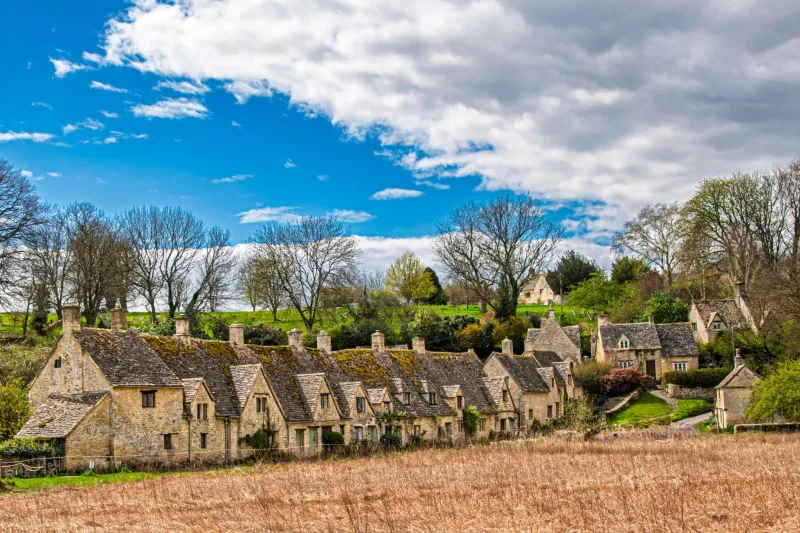
Photo: Mike Kirby, CC BY-SA 2.0, via Wikimedia Commons
The default British cottage break has a shape to it. You leave work early on Friday, sit in the same traffic as everyone else, arrive in the dark, spend Saturday in a village that is heaving, and drive home on Sunday with a bag of damp towels and a vague sense of having paid a lot for not very much. It is a shape built around annual leave and school runs rather than around value.
Shift the whole thing forward by two days and something odd happens. The price drops, the availability opens up, and the place you came to see is briefly yours again.
The Friday premium nobody puts on the invoice
Nearly every popular coastal and countryside cluster in the UK runs on a Friday or Saturday changeover. That single scheduling habit concentrates demand into two nights a week, and hosts price accordingly. A two-night weekend in high season is routinely advertised at 70–80% of the weekly rate — for less than a third of the nights. Midweek stays, by contrast, are often the thing hosts are quietly trying to fill, and the discounts reflect that anxiety.
The same logic applies to availability. If you are searching in late autumn for a summer week next year, the Friday-to-Sunday slots in the good cottages are the first to go. Sunday-to-Friday is where the gaps still are, particularly in cottages that only take short breaks outside peak season.
What a Sunday-to-Friday actually feels like
Sunday travel is noticeably quieter than Friday travel, especially after about 6pm. Monday to Thursday, the coast path is close to empty, the National Trust car parks have spaces, and the pub has a table that isn't booked for 7:30. You get four full days on the ground rather than one and a half, and a host who is far more relaxed about what time you turn up because they are not turning three cottages around in a five-hour window.
The trade-off is obvious: it costs more annual leave, and it doesn't work if you can only escape for a weekend. But if you have five days to spend, spending them Sunday to Friday is almost always better value than a Friday-to-Sunday plus three days of nothing at home.
Changeover days are not universal — check first
Do not assume every cottage runs Friday-to-Friday. Plenty of hosts use Saturday, some use Monday, and a growing number are genuinely flexible with a minimum-night rule instead of a fixed start day. Where a start day is fixed, it is often a cleaning-rota habit rather than a hard law of the building, so it is always worth asking whether a Sunday arrival is possible.
Watch the short-break rules too. Many cottages will not take a two-night booking in July and August, and some require four or five nights as a minimum in peak weeks. A Sunday-to-Friday of five nights usually slips through where a Friday-to-Sunday of two does not.
The pre-booking checklist
- Compare per night, not per stay. A five-night midweek at £700 and a two-night weekend at £420 look similar until you divide.
- Check what is bundled. Cleaning fees, hot-tub charges, logs, and per-dog fees can add £60–£150 to a short break.
- Confirm the changeover day and whether the host will flex it. Ask directly, in one sentence.
- Ask about minimum nights by season, not just for your dates.
- Note arrival and departure times. A 4pm arrival and 10am departure is a very different five nights from 3pm and 11am.
- Check the cancellation terms — midweek bookings are sometimes priced with stricter conditions.
- Look at what actually closes. Some rural museums, farm shops and attractions shut on Mondays and Tuesdays out of season.
Two worked examples
On the North Norfolk coast, a well-kept two-bedroom cottage a mile from the beach might list at £480 for a peak-summer Friday-to-Sunday and £680 for the same week's Sunday-to-Friday. That is roughly 40% more money for two and a half times the nights. In practice you are buying the quiet Tuesday.
In the Yorkshire Dales or the Peak District, the gap often widens outside school holidays. Late September and early October are prime midweek territory: hosts are chasing bookings after the summer rush, and a Sunday-to-Friday in a stone cottage with a wood burner can come in below the nightly rate of a competitive weekend break.
When the midweek move backfires
Be honest about your own trip. If you are going for a specific Saturday event, a market, a wedding or a family gathering, the maths changes completely. If the cottage is really a weekend party house with neighbours close by, midweek is a waste. And if you are driving six hours, arriving on a Sunday evening after a full week of work is not restful — it is just delayed exhaustion. Sometimes a Saturday-to-Saturday week is the sane answer.
How to ask for it
Keep it short and specific, and you will usually get a straight answer: 'We are looking at five nights, Sunday to Friday, in the week of [date]. Is the changeover day fixed, and is there any flexibility on the rate for a midweek stay?' Hosts who have an empty week in front of them tend to reply quickly.
The midweek dividend is not a secret code — it is just the consequence of everyone else booking the same two nights as each other. Move two days earlier and you stop competing with them.